


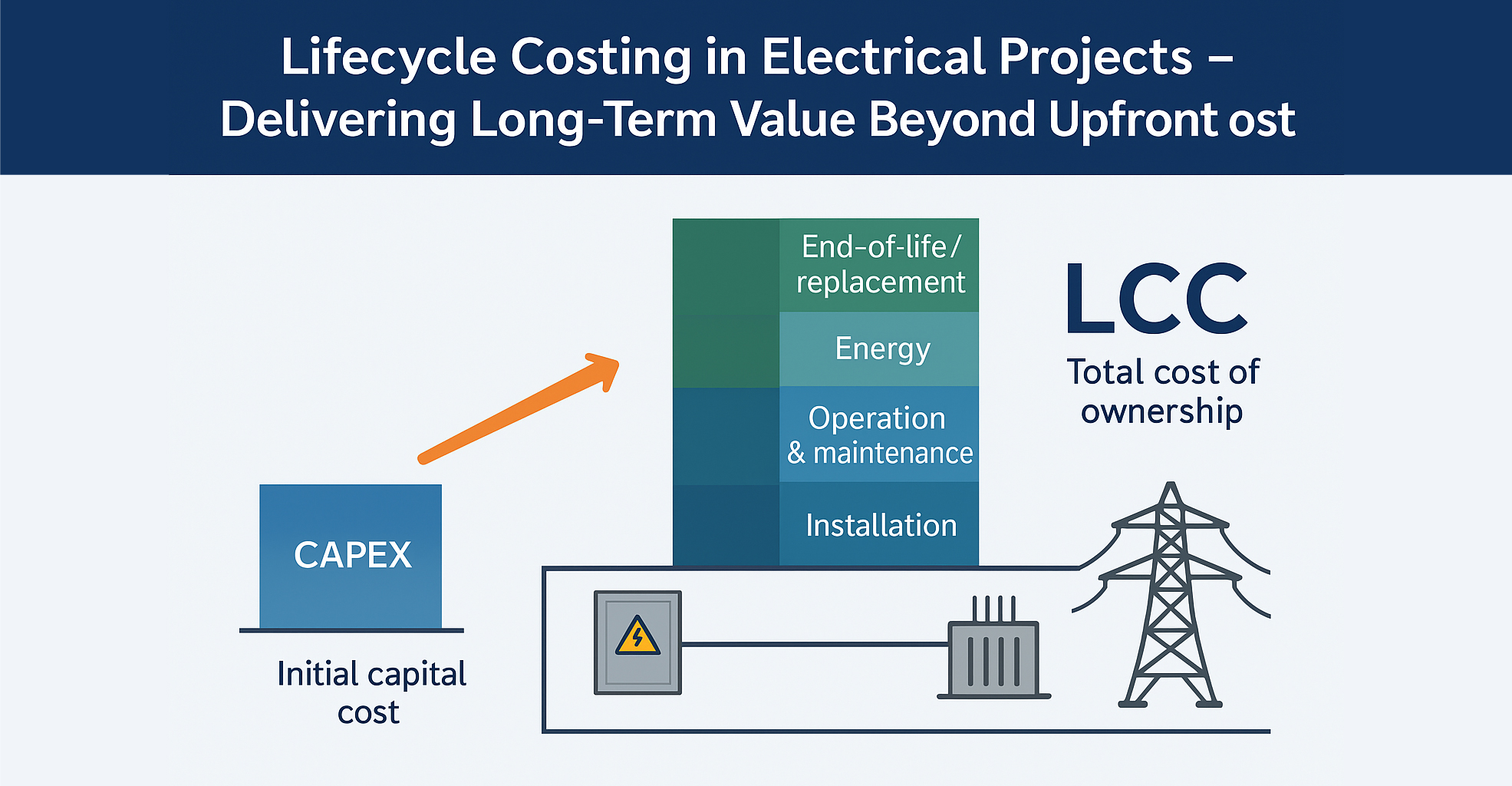
In electrical engineering, projects are often judged on their ability to meet technical requirements within budget and schedule. Too frequently, however, project evaluation focuses narrowly on capital expenditure (CAPEX), sidelining the costs that accumulate over the decades-long life of electrical infrastructure. Lifecycle Costing (LCC) offers a more strategic lens—one that considers not only the purchase price, but also operating, maintenance, reliability, and end-of-life costs. For both clients and contractors, applying LCC to projects ensures smarter investment decisions, sustainable performance, and long-term value creation.
What Lifecycle Costing Means
Lifecycle Costing is the process of assessing the total cost of ownership of an asset from acquisition through to disposal. For electrical projects, this involves not only material and installation costs, but also:
- Energy consumption and efficiency losses
- Operation and maintenance costs
- Downtime risks and reliability impacts
- Spare parts and service agreements
- End-of-life disposal, recycling, or replacement
This perspective is critical in electrical systems—where assets like switchgear, transformers, or protection devices may operate for 25–40 years. A seemingly small design decision today, such as specifying low-efficiency equipment, can lock in millions of dollars in extra operating costs across the project’s lifetime.
Why LCC Matters in Electrical Projects
- Optimized Capital vs. Operational Trade-offs
Project budgets often prioritize the lowest upfront cost, but this may undermine long-term performance. A higher initial investment in premium cabling, advanced protection relays, or digital monitoring systems can reduce energy losses, extend service life, and cut O&M costs. LCC makes these trade-offs visible. - Risk Mitigation and Reliability
Electrical projects often serve critical infrastructure—factories, hospitals, data centers, utilities. Reliability failures can cause enormous financial and reputational damage. By analyzing lifecycle costs, project teams can justify investment in higher-reliability designs that minimize downtime and safeguard business continuity. - Sustainability and Compliance
With increasing global focus on carbon reduction and energy efficiency, many projects must demonstrate not just financial viability, but environmental responsibility. LCC integrates energy savings, reduced emissions, and compliance with green standards into decision-making. - Stakeholder Confidence
Clients, financiers, and regulators prefer projects justified by transparent, data-driven methods. Incorporating lifecycle costing builds credibility and helps align stakeholders with a project’s long-term vision.
Applying LCC in Project Development
- Design Stage: Evaluate equipment and system alternatives based on total cost of ownership, not just initial price. Use modeling tools to simulate energy losses, maintenance intervals, and replacement cycles.
- Procurement Stage: Include lifecycle criteria in supplier evaluations—e.g., efficiency class of transformers, MTBF (mean time between failure) of switchgear, or digital monitoring features.
- Execution Stage: Document cost-saving features in commissioning reports and client handovers, reinforcing the project’s long-term value.
- Operation Stage: Support clients with maintenance strategies, predictive analytics, and periodic cost-benefit reviews to sustain value over time.
Delivering Projects Through LCC Thinking
By embedding lifecycle costing into project development, electrical engineers and contractors shift the focus from “lowest bid wins” to “best value delivered.” This not only enhances the competitiveness of proposals but also ensures that completed projects stand the test of time.
In practice, LCC transforms projects from short-term deliverables into long-term partnerships between engineers, clients, and stakeholders. It allows projects to be judged not just on day-one cost, but on decades of performance, efficiency, and sustainability. The real win is not in delivering a project cheaply, but in ensuring it continues to serve reliably, efficiently, and economically for its entire lifecycle. That is the hallmark of true engineering value.
Partner with Adepa Elektronik Ticaret for a more strategic perspective—one that goes beyond purchase price to include operating, maintenance, reliability, and end-of-life costs.
Comments are closed