


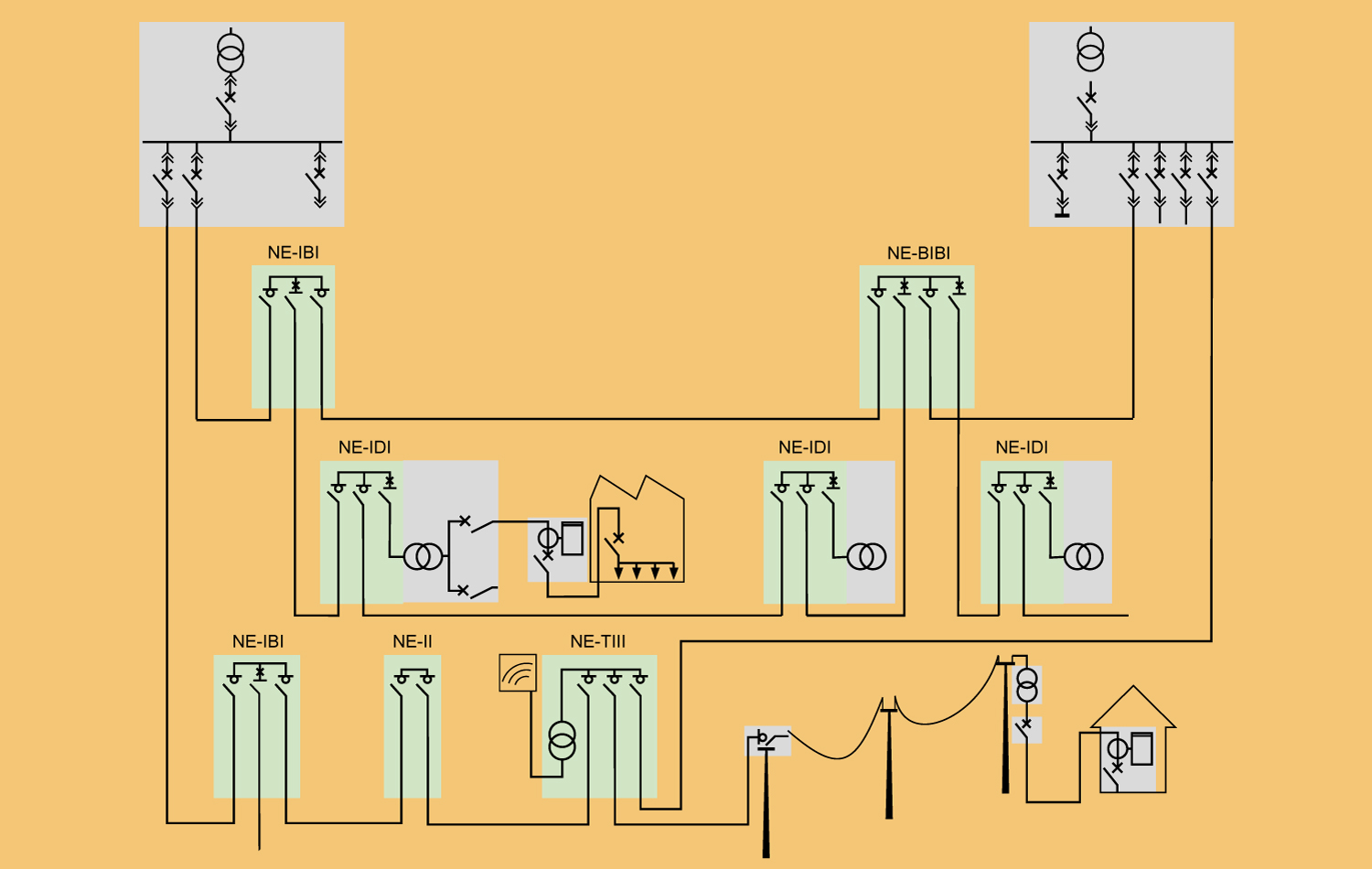
Directional relays play a critical role in power distribution systems, ensuring proper fault detection and isolation while maintaining system stability and reliability. These relays are particularly useful in complex networks where power flow can change direction, such as ring mains, parallel feeders, or interconnected grids.
PRINCIPLES OF DIRECTIONAL RELAYS
A directional relay determines the direction of fault currents and operates only when the fault lies in a predefined direction relative to the relay location. This selective operation helps avoid unnecessary tripping of circuit breakers and ensures that only the faulty section is isolated, minimizing disruption to the system.
Directional relays function based on the phase angle relationship between the voltage and current at their location. They typically use the following components:
- Polarizing Voltage: This voltage, usually derived from a potential transformer (PT) or voltage transformer (VT), serves as a reference to determine the direction of current flow.
- Operating Current: The current measured by a current transformer (CT) provides information on the magnitude and phase of the fault current.
- Angle Measurement: The relay measures the phase angle between the current and the reference voltage. If the angle falls within a predefined range (typically 0° to 90° for forward faults and 180° to 270° for reverse faults), the relay activates.
TYPES OF DIRECTIONAL RELAYS
- Directional Overcurrent Relays: These relays combine directional sensing with overcurrent protection, ensuring tripping occurs only when a fault in the specified direction exceeds a preset current threshold.
- Directional Distance Relays: These measure impedance along a line and trip based on both fault distance and direction, commonly used in transmission and sub-transmission networks.
- Directional Earth Fault Relays: Used in grounded systems, these relays detect ground faults by analyzing zero-sequence components of voltage and current.
REAL-WORLD APPLICATIONS OF DIRECTIONAL RELAYS
- Ring Main Distribution Systems: In urban power distribution networks, ring mains ensure redundancy by providing multiple supply paths. Directional relays are crucial in these systems to correctly identify the fault location and prevent unnecessary tripping of healthy feeders. For example, in a city’s 11 kV ring network, directional overcurrent relays ensure that a faulted section is isolated while power is maintained through alternate routes.
- Parallel Feeder Protection: In industrial plants or high-reliability zones, power is often supplied through parallel feeders. A fault in one feeder should not cause both feeders to trip. Directional relays ensure that only the affected feeder is disconnected. For example, in a steel plant operating on dual 33 kV feeders, directional relays ensure that faults on one feeder do not disrupt the other, improving system stability.
- Radial Networks with Embedded Generation: With increasing penetration of distributed generation (DG), radial networks are becoming bidirectional. Traditional overcurrent relays cannot distinguish between forward and reverse fault currents, leading to misoperations. Directional relays are essential in such cases. For instance, in a 33 kV network with a solar farm, a directional overcurrent relay ensures proper coordination when a fault occurs, preventing disconnection of healthy parts of the system.
- Transmission Line Protection in Interconnected Grids: In interconnected transmission networks, where power flows vary depending on load conditions, directional distance relays are commonly used. A practical example is a 132 kV transmission line between two substations in a national grid, where a directional relay ensures that a fault at one end does not unnecessarily trip breakers at both ends.
CONCLUSION
Directional relays are indispensable in modern power distribution systems, enabling selective fault clearance, enhancing network reliability, and facilitating the integration of renewable energy. Their application in ring networks, parallel feeders, embedded generation, and transmission systems ensures that power networks remain stable, efficient, and resilient against faults.
Comments are closed