


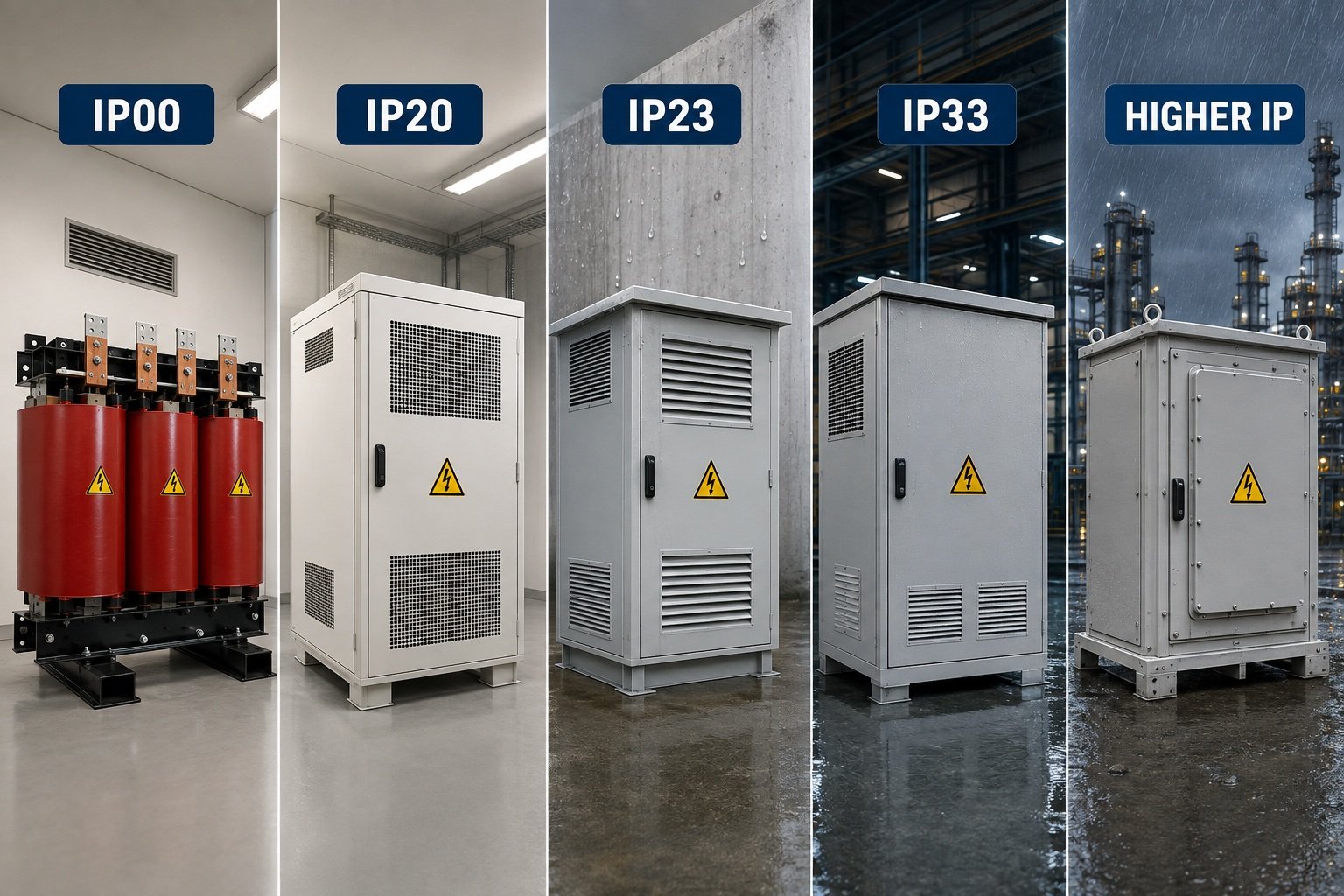
Cast resin dry-type transformers are widely used in commercial buildings, industrial plants, hospitals, data centers, infrastructure projects, and indoor substations because of their fire performance, low maintenance requirements, and suitability for installation close to electrical loads. However, one important specification that is sometimes treated as a secondary detail is the transformer enclosure IP rating.
Selecting the correct enclosure requires balancing two competing objectives: protecting the transformer from people and environmental conditions while maintaining sufficient airflow for effective cooling.
Understanding IP Ratings
The Ingress Protection (IP) classification defined by IEC 60529 describes the level of protection provided by an enclosure against access to hazardous parts, solid foreign objects, and water. Cast resin transformers may be supplied without a protective enclosure as IP00, or with enclosures providing ratings such as IP20, IP23, IP31, IP33, or higher depending on the manufacturer and application. For example, some manufacturers offer IP20, IP23 and IP33 as standard enclosure configurations, while higher ratings require special designs.
IP00 effectively means that the transformer itself has no enclosure protection. The windings and connections are exposed, so the transformer must be installed in a dedicated electrical room or compartment where unauthorized personnel cannot access energized components. Importantly, the cast resin surrounding the HV winding should not be considered protection against direct electrical contact.
The major advantage of IP00 is excellent natural ventilation. Air can circulate freely around the core and windings, allowing heat generated by transformer losses to escape efficiently. Consequently, IP00 is often technically attractive where the transformer room itself provides the required physical and environmental protection.
Moving to Higher Protection
Adding an enclosure improves personnel and environmental protection but changes the transformer’s thermal environment.
Ratings such as IP20 provide basic protection against access and relatively large solid objects. IP23 adds limited protection against water entering at an angle, making it useful where additional environmental protection is required. IP31 and similar configurations provide greater protection against solid objects and vertically falling water. Legrand, for example, identifies IP31 as its standard indoor enclosure for certain cast resin transformers, with other enclosure arrangements available for more demanding environments.
Higher ratings such as IP33, IP35, IP44 or specially engineered configurations may be considered for dusty, polluted, humid, industrial, semi-outdoor, or outdoor environments. However, a higher IP number should never automatically be interpreted as a better transformer specification.
The Cooling Trade-Off
A cast resin transformer normally relies on AN — Air Natural cooling. Heat from the windings and core must therefore transfer to the surrounding air and ultimately leave the transformer room.
As enclosure protection increases, ventilation openings generally become more restrictive. Louvers, screens, labyrinth arrangements, filters, or other barriers may reduce airflow. Poorly designed ventilation can increase the temperature of the air surrounding the transformer, reducing its ability to dissipate losses.
This can lead to higher winding temperatures, accelerated insulation ageing, temperature alarms, nuisance trips, reduced overload capability, or ultimately reduced transformer life.
Even a properly designed enclosure requires adequate external ventilation. Manufacturer installation guidance therefore specifies clearance around ventilation openings and requires the transformer room to dissipate equipment losses effectively.
For demanding applications, simply specifying a very high IP rating may therefore require additional engineering measures such as forced-air cooling, larger enclosure dimensions, specially designed ventilation paths, heat exchangers, water cooling, or air-conditioning. Manufacturers specifically recognize such engineered solutions for higher-protection enclosures.
Selecting the Right Enclosure
The enclosure should consequently be selected according to the actual installation environment, not by choosing the highest available IP rating.
A clean, restricted-access electrical room may favour IP00 because the room itself provides protection while maximizing natural cooling. Where personnel protection is required, IP20 or IP31-type arrangements may be appropriate. Locations exposed to dust, dripping water, pollution, humidity, or weather may justify IP23, IP33, IP35 or higher protection, subject to manufacturer confirmation.
Engineers should evaluate ambient temperature, transformer losses, ventilation, room dimensions, dust and moisture levels, accessibility, installation location, required clearances, cable entry arrangements, corrosion conditions, and whether natural or forced cooling will be used.
Ultimately, transformer enclosure design is an exercise in balance. Too little protection can expose equipment and personnel to unnecessary risk; excessive enclosure protection without adequate thermal engineering can compromise cooling performance.
The correct specification is therefore not simply “the highest IP rating available,” but the lowest appropriate IP rating that safely satisfies the environmental and personnel-protection requirements while preserving the transformer’s designed thermal performance.
Comments are closed