


Segregation in Low Voltage (LV) boards is a crucial design principle aimed at enhancing operational safety, reliability, and maintainability of electrical systems. It involves dividing the internal components of a distribution board or switchboard into separate compartments or zones to minimize the risks associated with electrical faults, unauthorized access, and maintenance activities. The implementation of segregation adheres to international standards such as IEC 61439, which provides guidelines for assembly design and protection levels.
TYPES
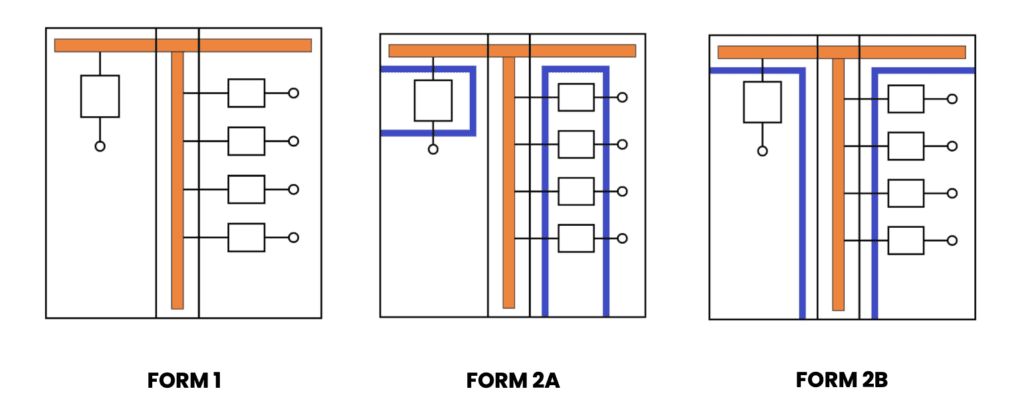
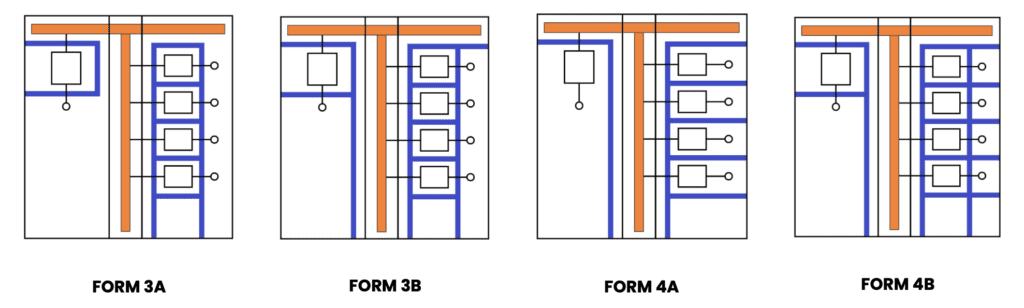
Segregation levels in LV boards are categorized into four main forms, as specified by IEC standards:
Form 1: No Internal Separation
This basic form has no separation between functional units, busbars, or terminals. It is the simplest and least costly design but offers minimal safety and maintenance advantages.
Form 2: Separation of Busbars from Functional Units
In this design, busbars are separated from the functional units but not from each other. It provides limited safety, allowing some protection during maintenance but not full isolation.
Form 3: Separation of Functional Units from Each Other and from Busbars
Each functional unit is isolated, and the busbars are fully separated. This enhances safety by preventing the spread of faults between units and enables selective access during maintenance.
Form 4: Complete Separation of All Functional Units and Their Terminals
This is the highest level of segregation, offering maximum safety and flexibility. Each unit and its terminals are individually isolated, ensuring complete protection during maintenance or fault conditions.
BENEFITS
Segregation in LV boards provides several advantages that ensure safety, reliability, and ease of maintenance.
Enhanced Safety
By isolating live components and functional units, segregation minimizes the risk of accidental contact with live parts during operation or maintenance. It reduces the likelihood of arc faults spreading within the board, safeguarding personnel and equipment.
Improved System Reliability
Faults in one functional unit are confined, preventing cascading failures that could disrupt the entire electrical system. This containment ensures uninterrupted operation of unaffected sections of the board.
Ease of Maintenance
Segregation allows maintenance personnel to work on specific sections of the board without shutting down the entire system. It simplifies troubleshooting and replacement of components, reducing downtime and associated costs.
Compliance with Standards
Adhering to segregation guidelines ensures compliance with safety and performance standards, which is crucial for regulatory approval and risk management.
Customization and Flexibility
Segregation designs can be tailored to meet specific operational requirements, making it suitable for a wide range of industries, including commercial, industrial, and critical infrastructure applications.
In conclusion, segregation in LV boards is a fundamental design strategy that prioritizes safety, reliability, and maintainability. By selecting the appropriate form of segregation based on system requirements and operational risks, engineers can create robust electrical systems that protect personnel, minimize downtime, and ensure long-term performance.
Looking for custom-designed LV panels with form segregation that comply with international standards like IEC 61439? Get in touch with us today for reliable LV panel solutions!
Comments are closed