


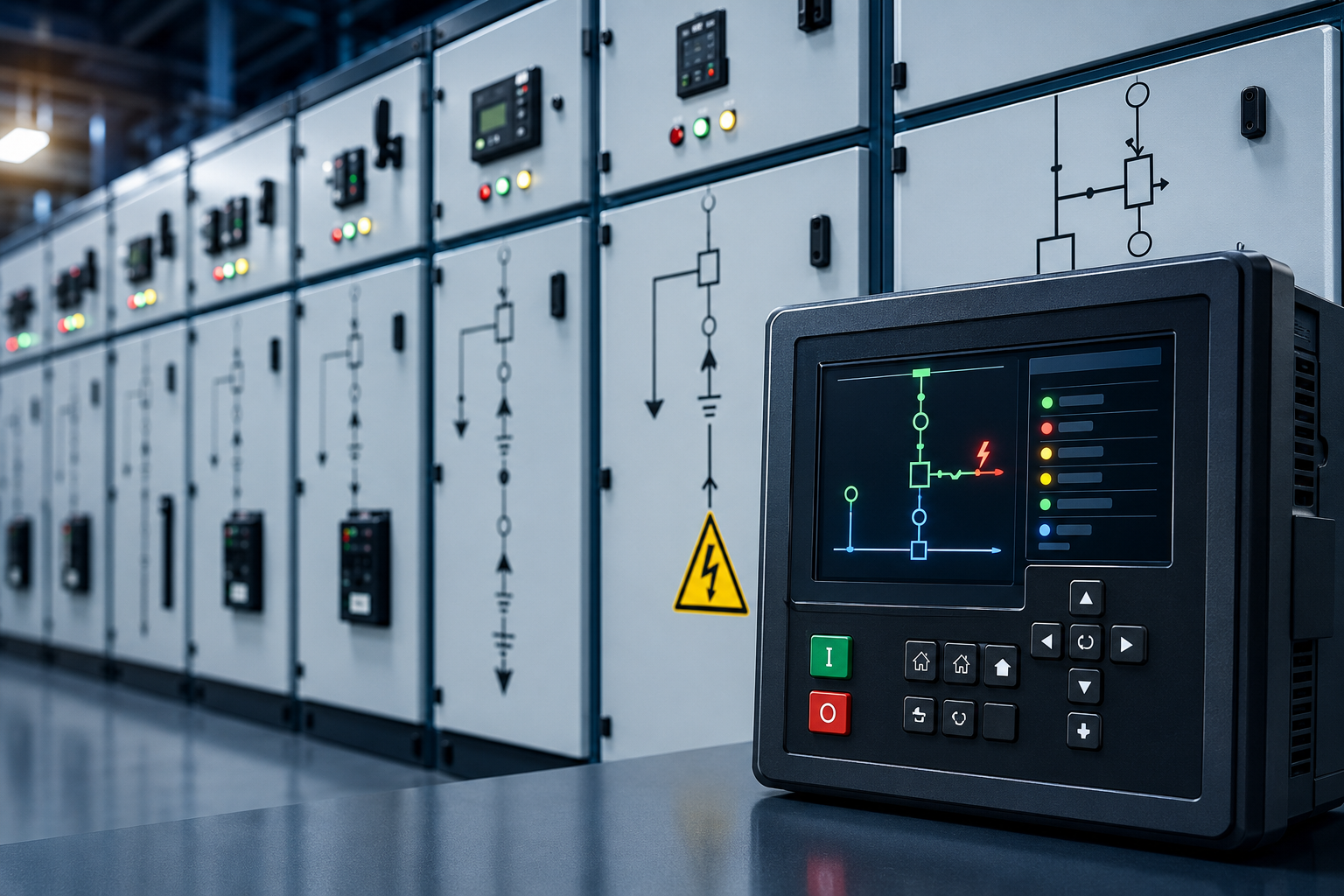
Protection relay coordination is one of the most critical aspects of electrical power system design. Modern switchgear installations rely on intelligent protection relays to detect abnormal operating conditions and isolate only the faulty section of the network while maintaining service continuity to healthy circuits. Proper relay coordination minimizes equipment damage, reduces downtime, enhances personnel safety, and improves overall system reliability.
The primary objective of relay coordination is selectivity. When a fault occurs, only the protective device closest to the fault should operate, leaving upstream breakers closed whenever possible. Without proper coordination, a minor fault on a single feeder could unnecessarily trip the main incoming breaker, interrupting power to an entire facility. This selective operation is achieved by carefully coordinating the operating times and current settings of protective relays throughout the switchgear system.
Relay coordination begins with a comprehensive power system study. Engineers first perform load flow, short-circuit, and equipment rating analyses to determine normal operating currents and maximum prospective fault currents. Based on these calculations, suitable current transformers (CTs), circuit breakers, and digital protection relays are selected. Relay settings are then configured to distinguish between normal load conditions, temporary overloads, motor starting currents, and genuine fault conditions.
A key tool in relay coordination is the Time-Current Characteristic (TCC) curve. By plotting the operating characteristics of relays and circuit breakers on a common graph, engineers verify that downstream devices clear faults before upstream protection operates. Adequate coordination margins account for breaker interrupting times, relay tolerances, CT errors, and system uncertainties. Proper TCC coordination prevents nuisance tripping while ensuring rapid fault clearance.
Modern numerical protection relays provide far greater flexibility than traditional electromechanical relays. Adjustable pickup settings, multiple protection curves, programmable logic, event recording, oscillography, and communication capabilities allow engineers to optimize protection for complex power systems. Functions such as overcurrent (50/51), earth fault (50N/51N), differential protection (87), distance protection (21), under and over-voltage (27/59), frequency protection (81), and breaker failure protection (50BF) can all be integrated into a single intelligent electronic device (IED).
Communication protocols such as IEC 61850 have transformed protection coordination. High-speed peer-to-peer communication using GOOSE messaging enables advanced protection schemes including busbar protection, transfer tripping, and interlocking with response times measured in milliseconds. These technologies significantly improve system stability while reducing fault clearing times.
Relay coordination becomes increasingly challenging in systems with multiple power sources, distributed generation, solar photovoltaic plants, battery energy storage systems, and standby generators. Fault current magnitude and direction may change depending on operating conditions. Directional overcurrent relays and adaptive protection schemes automatically adjust settings according to network configuration, ensuring reliable protection under varying system conditions.
Routine testing and periodic review are equally important. Power systems evolve as additional loads, transformers, or generators are installed. Previously coordinated settings may no longer provide adequate protection. Primary injection testing, secondary injection testing, and protection system audits verify relay performance and confirm that coordination remains effective throughout the system’s lifecycle.
Ultimately, advanced protection relay coordination is far more than adjusting relay settings—it is a comprehensive engineering discipline that combines system analysis, protective device selection, communication technology, and rigorous testing. When properly implemented, coordinated protection limits equipment damage, reduces arc flash energy, improves operational reliability, and maintains continuous power supply to critical processes. For industrial facilities, commercial buildings, utilities, and infrastructure projects, investing in well-coordinated switchgear protection is essential for achieving safe, resilient, and highly reliable electrical power systems.
Comments are closed